
How we work NiVACK’s signature framework

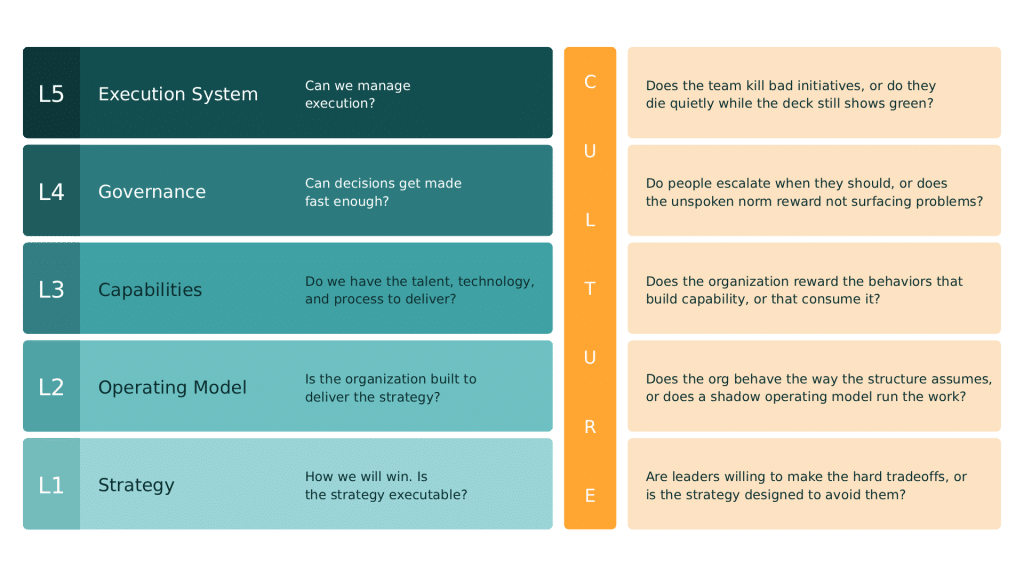
The Strategy-Execution Architecture Stack.

Strategy fails when the architecture underneath it cannot deliver. Our work is to design that architecture.

The PREMISE

Most strategies don't fail because leaders chose the wrong direction.

They fail because the organization lacks the operating model, governance, capabilities, and execution systems required to deliver them.

This is not a strategy problem. It is an architecture problem. And it cannot be solved by another planning offsite, another transformation program, or another PMO.

The organizations that consistently turn strategy into outcomes have something in common. The five layers of their operating architecture are aligned. When one layer is weak, or out of step with the others, execution breaks. Quietly at first, and then visibly.

The five layers.

ONE OPERATING ARCHITECTURE. FIVE INTERDEPENDENT LAYERS.

Strategy

Is the strategy executable?

Strategic priorities are clear. Tradeoffs are explicit. Outcomes are measurable. The strategy is built with input from the people who will execute it, not in isolation from them.

Where it breaks: Strategy that lives only in PowerPoint. Priorities without tradeoffs. Five-year plans that die in year one. Strategy disconnected from budget.

Operating Model

Is the organization structured to deliver the strategy?

Roles, structures, and workflows match what the strategy requires. Cross-functional coordination works. Decision-making sits at the right altitude.

Where it breaks: Functional silos. Matrix structures with no accountability. Operating models built for yesterday’s strategy. Coordination that depends on heroics rather than design.

Governance

Can the organization make decisions fast enough to act?

Decision rights are defined. Forums are clear. Accountability is owned. Escalation paths work. Leadership alignment is real, not performative.

Where it breaks: Slow-decision organizations. Consensus cultures that mistake meetings for movement. Leadership teams that look aligned in the room and pursue different priorities outside it.

Capabilities

Does the organization have what the strategy requires?

The talent, processes, and systems the strategy assumes actually exist, or there is a credible plan to build them. Capability investments follow strategy, not fashion.

Where it breaks: Strategy that assumes capabilities the organization doesn’t have. Critical skills trapped in silos. Capability investments disconnected from where the business is going.

Execution

Is there a system that turns intent into outcomes?

Initiatives have owners. Progress is measured by outcomes, not activity. Cross-functional work has structure. Feedback loops shape what comes next.

Where it breaks: Initiative overload. Program management theater. Tracking activity instead of outcomes. Strategic initiatives that quietly become business-as-usual.

What we look for first

The five questions that tell us where execution is breaking.

When we start an engagement, we ask five questions, one per layer. The answers reveal where the architecture is sound, where it’s misaligned, and where it’s actively producing the symptoms the leadership team is feeling.

Most organizations score well on one or two layers and have meaningful gaps in the others. The gaps are rarely where leadership thinks they are. That’s why the first move is diagnosis, not prescription.

ARCHITECTURE HEAT MAP
STRONG MODERATE WATCH CRITICAL
STRENGTH BY LAYER
STRATEGY
OPERATING MODEL
GOVERNANCE
CAPABILITIES
EXECUTION
Overall strength
STRONG
MODERATE
CRITICAL
MODERATE
WATCH
Strategy STRONG
Operating Model MODERATE
Governance CRITICAL
Capabilities MODERATE
Execution WATCH
Illustrative only. No client data is shown.

How we engage

Most of our work follows the same arc

01

Start with a Diagnostic.

Four to six weeks. We assess your organization across the five layers, identify where execution is breaking, and produce a clear read on what to do about it. The output is a heat map of architectural strengths and gaps, a prioritized set of recommendations, and a defensible roadmap for what comes next.

02

Move to Architecture work.

Most Diagnostics lead to focused engagements on the layers that need redesign. Operating model work. Governance redesign. Capability architecture. Execution system design. The scope follows what the Diagnostic surfaced, not a pre-packaged service line.

03

Stay until the work is delivered.

We don’t hand over a deck and disappear. We design for capability transfer, so the organization can sustain the work without us.

Who this is for

The leaders who get the most from our work tend to share three things.

They run complex organizations.

Multiple business units, multiple geographies, multiple stakeholders, or all three. The complexity is the reason simple fixes don’t work.

They have a strategy. A real one.

The problem isn’t that they don’t know where they’re going. The problem is that the organization can’t get there.

They want the truth.

They’re past the point where another optimistic transformation plan is useful. They want a clear-eyed read on what’s actually broken, and a serious plan to fix it.

Our work spans technology, healthcare, and state and local government. The pattern is the same across sectors. Strategy is rarely the problem. Architecture is.

what this looks like in practice

What this looks like in practice.

Semiconductor

A Fortune 500 semiconductor manufacturer had committed to a global procurement transformation that wasn’t delivering. The strategy was sound. The operating model wasn’t. We redesigned the global procurement operating model, established the governance and capability architecture required to support it, and built the execution system that turned strategic intent into measurable value capture. The function moved from cost-control to a strategic capability.

Public sector

A California state agency was responsible for delivering a high-visibility statewide initiative. The strategic plan was clear. Execution authority was fragmented across divisions, and decisions stalled. We redesigned the governance and decision architecture, built the execution infrastructure to coordinate across divisions, and established a system the agency could sustain after we left.

Healthcare

A regional health system had completed strategic planning but couldn’t translate the plan into operational change. We diagnosed the gap across the five layers, redesigned the operating model and capability architecture, and built the execution system that converted strategic intent into measurable outcomes.